 Add to Chrome
 Add to Firefox
 Add to Edge
SafeMed-R1: Clinician-Audited Safety and Ethics Alignment for Medical Large Language Models
May 27, 2026
Large language models(LLMs) increasingly match expert performance on licensing examinations, yet routine clinical use remains limited because governance requires auditable reasoning, safety and ethics alignment, and resilience to adversarial misuse. Here we present SafeMed-R1, trained with a traceable Clinical Trust Signals(CTS) pipeline that links each reasoning instance to clinician rubric scores and edit histories, and aligned through safety and ethics supervision and red team stress testing. SafeMed-R1 attains a macro-averaged accuracy of 79.6% across clinical benchmarks. Under adversarial safety testing, it shows the lowest aggregated risk and reduces unsafe outputs by about 3 to 5% relative to its baseline. In a paired expert study of 30 medication safety vignettes, SafeMed-R1 matches PGY1 and PGY2 residents on medical correctness and scores higher for medication safety, guideline consistency, and clinical usefulness. Collectively, these results suggest that clinician-audited supervision provenance, together with domain-tailored safety and ethics alignment, can strengthen governance-relevant evidence without relying on inference-time retrieval or citation grounding.

Fin-RATE: A Real-world Financial Analytics and Tracking Evaluation Benchmark for LLMs on SEC Filings
Feb 07, 2026With increasing deployment of Large Language Models (LLMs) in the finance domain, LLMs are increasingly expected to parse complex regulatory disclosures. However, existing benchmarks often focus on isolated details, failing to reflect the complexity of professional analysis that requires synthesizing information across multiple documents, reporting periods, and corporate entities. They do not distinguish whether errors stem from retrieval failures, generation flaws, finance-specific reasoning mistakes, or misunderstanding of the query or context. This makes it difficult to pinpoint performance bottlenecks. To bridge these gaps, we introduce Fin-RATE, a benchmark built on U.S. Securities and Exchange Commission (SEC) filings and mirror financial analyst workflows through three pathways: detail-oriented reasoning within individual disclosures, cross-entity comparison under shared topics, and longitudinal tracking of the same firm across reporting periods. We benchmark 17 leading LLMs, spanning open-source, closed-source, and finance-specialized models, under both ground-truth context and retrieval-augmented settings. Results show substantial performance degradation, with accuracy dropping by 18.60% and 14.35% as tasks shift from single-document reasoning to longitudinal and cross-entity analysis. This is driven by rising comparison hallucinations, time and entity mismatches, and mirrored by declines in reasoning and factuality--limitations that prior benchmarks have yet to formally categorize or quantify.
EpiPlanAgent: Agentic Automated Epidemic Response Planning
Dec 12, 2025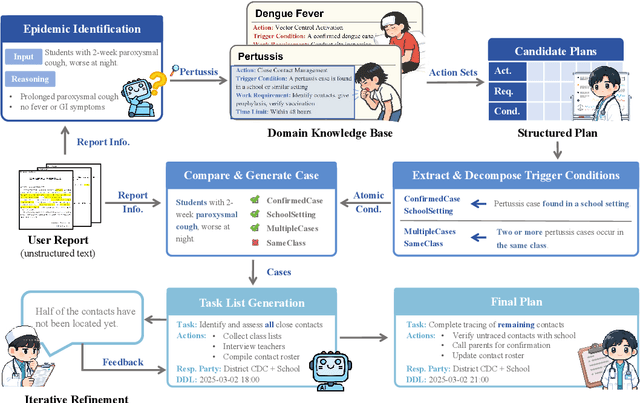

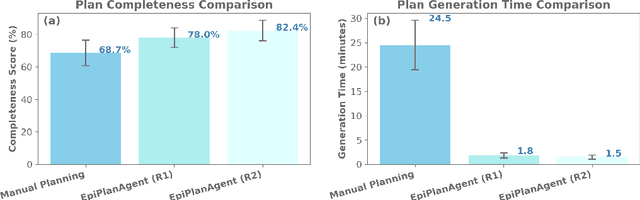
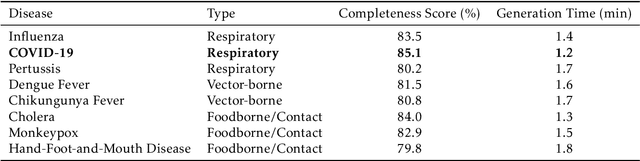
Epidemic response planning is essential yet traditionally reliant on labor-intensive manual methods. This study aimed to design and evaluate EpiPlanAgent, an agent-based system using large language models (LLMs) to automate the generation and validation of digital emergency response plans. The multi-agent framework integrated task decomposition, knowledge grounding, and simulation modules. Public health professionals tested the system using real-world outbreak scenarios in a controlled evaluation. Results demonstrated that EpiPlanAgent significantly improved the completeness and guideline alignment of plans while drastically reducing development time compared to manual workflows. Expert evaluation confirmed high consistency between AI-generated and human-authored content. User feedback indicated strong perceived utility. In conclusion, EpiPlanAgent provides an effective, scalable solution for intelligent epidemic response planning, demonstrating the potential of agentic AI to transform public health preparedness.